Problem
Wake’s stream (its main activity feed) was great for seeing what people were working on, but weak at showing history.
Iterations were scattered across multiple posts like “Homepage v2” and “Header refinement.” That split the discussion and led to duplicate questions plus constant “which version is this?” confusion. Teams tried to patch the gap with hacks like naming files “v3 / final_final,” digging through old posts, or linking out to design tools.
Wake needed a lightweight way to bundle related iterations into one durable narrative without turning into heavy version control.
Insights
Teams wanted version history to live inside Wake so they could share work fast and stay in flow while still trusting clear timestamps and brief human notes over automated diffs.
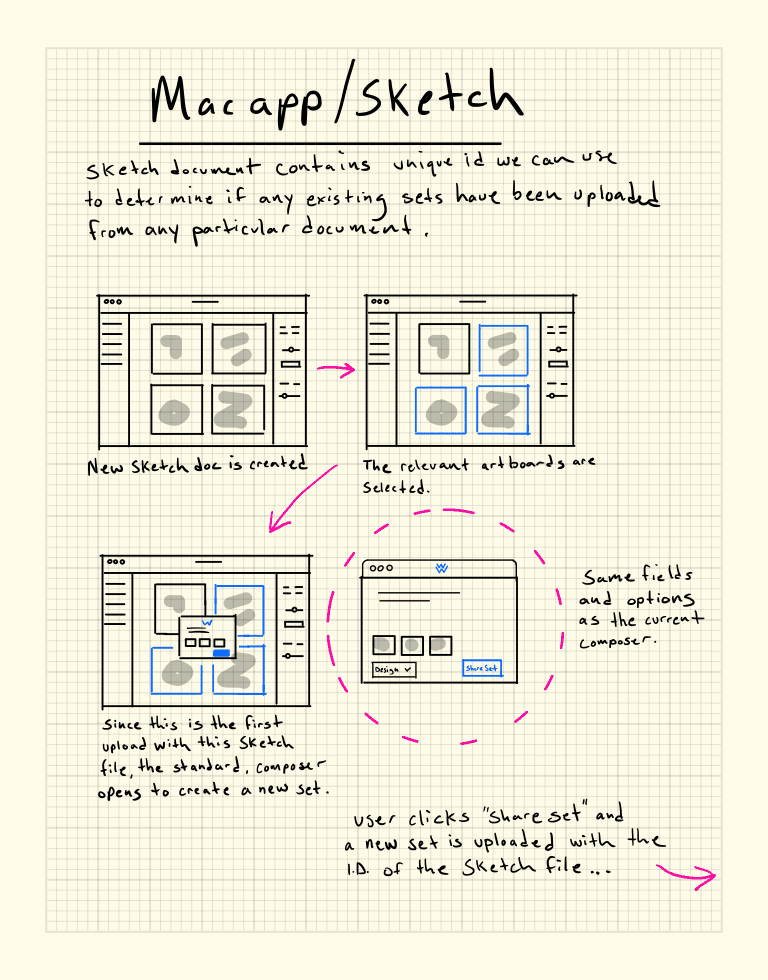
On the implementation side, Sketch document IDs and art board identifiers emerged as reliable anchors for tying uploads back to the right version stack.
Solution
We treated each post as a container for a stack of snapshots, not a single upload.
How It Works:
Designers share art boards from Sketch via the Mac app, just as before. Wake uses Sketch document + art board IDs to decide whether to:
Create a new item (new art board), or
Add a new snapshot to an existing item (same art board).
Each snapshot stores image, author, timestamp, and an optional user-generated note like “Header nav tightened 8 px.”
Inside the post, Versioning adds:
Inline History View to browse snapshots over time without leaving the stream.
Compare Mode to scrub through versions or pick two snapshots for side‑by‑side comparison via a simple slider.
A shared thread carries discussion across versions, while snapshot-specific annotations keep precise feedback attached to the relevant image.
The result is one canonical thread where visuals, comments, and annotations evolve together.
Key Design Decisions
One Thread, Many Snapshots: Use underlying IDs instead of fragile filenames so updates are predictable and safe.
Compare in Place: Keep history and compare inside the post, rather than on a separate history page, so reviewers never lose context.
Conversation-First: Preserve a single comment thread while anchoring precise feedback to individual snapshots.
Prioritize Reliability and Speed: Deprioritize heavy automation and one-click restore in the MVP in favor of predictable stacking, fast capture, and a simple, stream-centric mental model.
Impact
Qualitative feedback described changes in how teams shared and reviewed work.
Outcomes:
Teams created fewer duplicate posts as they updated existing work.
Conversation consolidated around canonical threads, increasing comments per post and reducing “which version is this?” confusion.
Teams reached design consensus faster, spending less time reconstructing history before reviews.
Stakeholders reported higher confidence that they were looking at the latest version and could still see “how we got here” in one place.
Qualitatively, designers described Versioning as turning Wake from a stream of screenshots into a living project history.



Next Opportunities
Proposed future improvements include letting reviewers tag key snapshots with milestone labels like usability testing, stakeholder review, or dev handoff. We also saw room for optional visual diff overlays on complex screens when teams need finer change detection. Longer term, deeper integrations with design tools and source control could capture important versions automatically at commits or merges and project-level overviews could highlight where work is changing and where feedback is still unresolved.